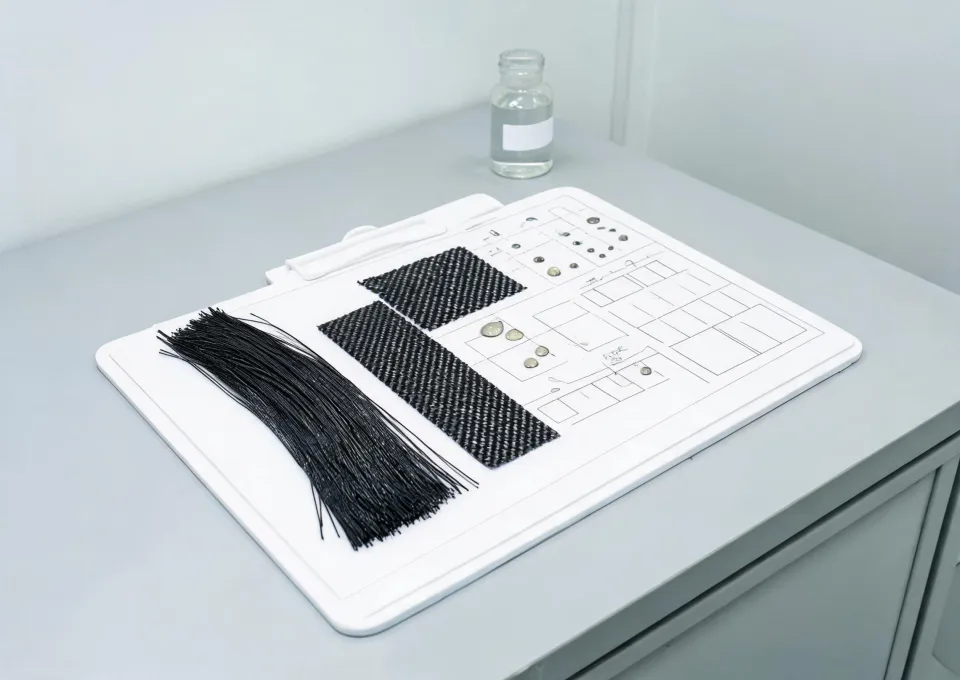

Reference composite reinforcement development inputs
Reference state

Toray Material Innovation

Define the reinforcement, sizing, matrix and process window before judging a material innovation claim.

Controlled composite material prototypes under evaluation
Trial state

Compare one changed variable

Hold laminate architecture and test conditions constant so engineers can interpret the effect of each development route.

Development scenario builder

Calculate the evidence workload, not a marketing score

Changing reinforcement feedstock, sizing chemistry, resin system or cure route can alter wet-out, interfacial response, mechanical performance and process repeatability. The interface identifies which specimens and tests need repetition when one input changes.

Enter project quantities during a technical consultation; this static demonstration defines decision fields without inventing performance or environmental savings.

Review setFeedstock traceability · fiber architecture · interfacial response · mechanical baseline · process window · report scope

Three innovation routes with explicit trade-offs

Reclaimed fiber integration

Background: A program may investigate reclaimed carbon fiber while retaining useful reinforcement consistency. Process: Record feedstock origin, fiber-length distribution and architecture, then compare laminate coupons against a controlled virgin-fiber reference. Result boundary: Reclaimed content alone does not establish lower life-cycle impact, and variation in fiber condition may narrow suitable applications.

Sizing and interface studies

Background: Sizing chemistry influences handling, resin wet-out and load transfer at the fiber-matrix interface. Process: Hold fiber form, matrix and cure schedule constant while screening compatibility and agreed interfacial or mechanical methods. Result boundary: A result for one resin and cure window cannot be generalized to another system without repeat validation.

Prepreg process development

Background: Resin formulation and prepreg format affect tack, handling, storage, cure behavior and laminate quality. Process: Record resin content, reinforcement areal weight, storage history, out-time, layup and cure conditions before testing representative coupons. Result boundary: Faster or lower-temperature processing can introduce trade-offs in shelf life, consolidation or final properties that require program-specific review.

Design a controlled material innovation trial.

Identify the reference construction, the variable being changed and the decision methods.